The gap between validation mAP and field performance is where detection projects die. I’ve trained models for orchards at noon and ports at midnight — here’s the discipline that closes the gap.
Data beats architecture, every time
Switching YOLOv8-s to YOLOv8-m might buy 2 points of mAP. Fixing your dataset routinely buys 10. Spend your budget here:
- Collect from the deployment cameras, not from the web. Same sensor, same angles, same lighting. Web-scraped data trains a model for somebody else’s problem.
- Label what you’ll be graded on. If night shift matters, night data must be a first-class split, not 3% of the set.
- Audit labels before training. A day spent fixing boxes — tight, consistent, one policy for occlusion and truncation — outperforms most hyperparameter tuning. Mislabeled small objects actively teach the model to be wrong.
Augment for ugly, not for benchmarks
Default augmentation pipelines are tuned for COCO leaderboards. Field conditions are harsher: rain, glare, dust, motion blur, extreme low light. Build augmentation around your deployment:
- Brightness/contrast/exposure jitter wide enough to cover dawn-to-midnight lux swings.
- Motion blur and compression artifacts if the feed is a re-encoded RTSP stream (it usually is).
- Mosaic and mixup for small-object density, but verify they don’t destroy the spatial priors your scene actually has (e.g., horizon lines in CCTV).
Start from pretrained, freeze wisely
Train from COCO-pretrained weights unless you have millions of boxes. Freeze the backbone for the first epochs to stabilize the head, then unfreeze with a lower backbone learning rate. Full fine-tuning from epoch zero on a small dataset is how you destroy good features and memorize noise.
Hyperparameters that actually matter
- Image size: train at (or near) deployment resolution. Training at 640 and deploying at 1280 shifts the feature statistics.
- Learning rate schedule: cosine decay with a short warmup is boring and works. One-cycle can train faster but is touchier on small data.
- Class imbalance: if one class dominates 10:1, reweight the loss or oversample — otherwise the model learns that “always guess background” is a fine strategy.
Evaluate like the field will
- Report per-class recall at your operating confidence threshold, not just [email protected]. The threshold you’ll deploy at is the only one that counts.
- Keep a held-out field set from different days/cameras than training. Same-day validation lies.
- Measure latency and memory on the target device as first-class metrics. A 55-mAP model that can’t run on your Jetson is a 0-mAP model.
- Log failure modes, not just scores: missed small objects? False positives on shadows? Each failure mode maps to a data fix, which maps to the next training round.
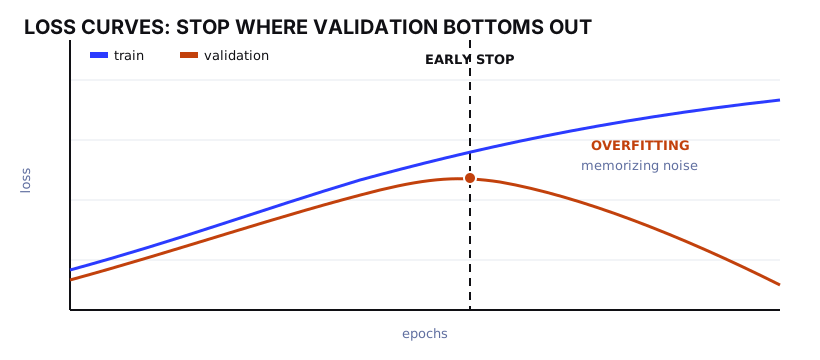
- Stop at the bottom of the validation curve, not at a fixed epoch count. Training loss will keep falling long after the model starts memorizing noise — the validation minimum is the model you ship.
The loop
Collect field data → audit labels → train from pretrained → evaluate per-class at operating threshold on held-out field footage → fix the data the failures point at → repeat. Most “model problems” are data problems wearing a trench coat. Run the loop and the field stops being scary.
← All posts